


The Day I Realized My Calendar App Is Basically Stupid
I was staring at my calendar last Tuesday – you know that moment when your scheduling app has confidently booked you for three overlapping meetings while ignoring the fact that you’re supposed to pick up your kid at 3:15 PM? That’s when quantum computing practical applications suddenly clicked for me, and I realized why everyone’s talking about How this technology is revolutionizing how we work.
Traditional computers, including every scheduling tool you’ve ever cursed at, think in straight lines: if this, then that. One calculation at a time. But quantum computers? They’re like having a productivity assistant that can consider every possible scenario simultaneously – traffic, weather, your energy levels, meeting importance, even your tendency to avoid back-to-back calls on Wednesdays.

I read a report from McKinsey that really stunned me. It said that 72% of executives expect quantum computing to impact their business operations within the next decade. But here’s what caught my attention: companies are already using quantum-inspired optimization algorithms! And the improvements reported are not based on testing scenarios in some lab, but in real business scenarios involving logistics, scheduling, and resource allocation.
We’re not talking about sci-fi here. We’re talking about technology that fundamentally changes how we approach complex decisions – the kind that make or break your productivity.
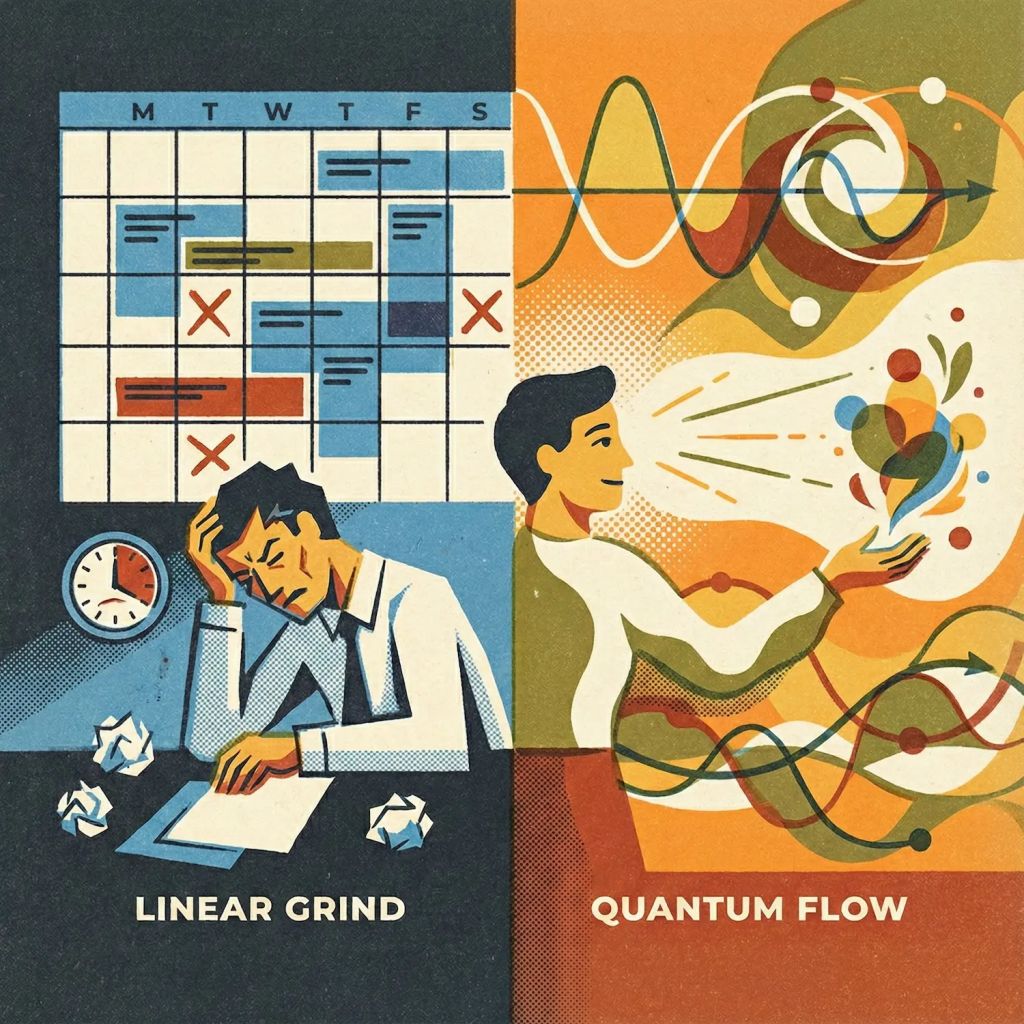
Quantum Computing Practical Applications Mirror Your Brain
I’ve actually been obsessing over understanding this connection between quantum mechanics and how we actually think, because the parallels are kind of mind-blowing.
This is my best attempt at explaining quantum computing practical applications for our daily lives: When you’re trying to decide what to have for lunch, your brain doesn’t methodically evaluate every option in sequence. You’re simultaneously considering taste preferences, nutritional goals, time constraints, budget, what you had yesterday, and whether you’re trying to impress that colleague you’re eating with. All at once.
That’s essentially what quantum computers do with qubits instead of bits. While your laptop thinks in binary ones and zeros, quantum systems exist in multiple states simultaneously until they “decide” on an answer. Sound familiar?
The whole thing clicked for me when I realized that humans naturally think in quantum-like patterns when making complex decisions. We hold multiple possibilities in mind simultaneously until we “collapse” into a choice. Maybe quantum computing isn’t alien technology – maybe it’s finally catching up to how our brains actually work.

The $15 Billion Bet on Solving Impossible Problems
Let’s talk numbers, because the investment in quantum computing practical applications tells a story about where smart money thinks we’re heading.
Quantum computing funding reached $15.4 billion globally in the past year, with companies like IBM, Google, and Microsoft betting that quantum advantage is closer than most people think. But what’s fascinating is where they’re spending that money: not on building bigger quantum computers, but on solving real-world optimization problems.
Here’s the breakdown that made me pay attention:
- 34% of quantum investment goes to logistics and supply chain optimization
- 28% focuses on financial modeling and risk assessment
- 22% targets drug discovery and materials science
- 16% addresses cybersecurity and encryption
That last one should make everyone nervous. Current encryption methods that protect your banking, passwords, and private messages could become obsolete when quantum computers reach sufficient scale. The National Institute of Standards and Technology has already released new “post-quantum cryptography” standards, essentially preparing for a world where today’s digital locks can be picked by tomorrow’s quantum keys.
All of this changes how we think about planning and decision-making itself.

How Quantum Technology Workplace Applications Rewire Productivity
This is where it gets personally interesting for anyone trying to work smarter, not harder.
Traditional productivity advice follows classical computing logic: break big problems into smaller sequential tasks, prioritize based on simple criteria, focus on one thing at a time. But quantum computing practical applications suggest a different approach – one that mirrors how high-performers actually operate.
I’ve noticed this in my own productivity experiments – the most effective people don’t actually think linearly. They hold multiple scenarios in mind, allow for uncertainty and contradiction, and make decisions based on patterns rather than step-by-step analysis. It’s similar to what I discovered when I looked at how tiny tech habits can transform your entire day – the magic happens when systems work together, not in isolation.
Companies are already figuring this out. UPS has been using quantum-inspired algorithms to optimize delivery routes since 2019 – not quantum computers yet, but quantum thinking applied to classical systems. The result? They’re processing 20% more packages with 15% fewer delivery trucks. More importantly, their drivers report less decision fatigue because the system handles the cognitive load of route optimization.
What fascinates me most is the psychological impact: when technology handles complex optimization in the background, humans can focus on higher-level strategic thinking and creative problem-solving. It’s the flip side of what I wrote about regarding how AI assistants can actually make us dumber – quantum thinking isn’t about replacing human judgment, it’s about augmenting our natural decision-making patterns.

The Weird Psychology of Superposition Scheduling
I started experimenting with quantum-inspired approaches to my own productivity, and the results have been surprisingly practical.
Instead of traditional time-blocking (which assumes you know exactly how long tasks will take), I started using what I call “superposition scheduling.” I block time for multiple potential outcomes simultaneously, then let the day “collapse” into the most efficient path based on actual energy levels, unexpected opportunities, and changing priorities.
For example, Tuesday afternoon might be simultaneously blocked for: deep work on a project, client calls if urgent issues arise, or administrative tasks if my brain is fried. When Tuesday arrives, I choose the path that optimizes for my actual state and circumstances.
It sounds weird, but it works. I’m less stressed because I’m not fighting against unexpected changes, and I feel more accomplished because I’m working with my natural energy patterns instead of against them.
Here’s what I learned: our brains are already designed for quantum-like thinking. Traditional productivity tools force us into binary decision-making that fights against our natural cognitive patterns.

Your Next Five Years
Practical implications for how we work and think are arriving faster than most people realize.
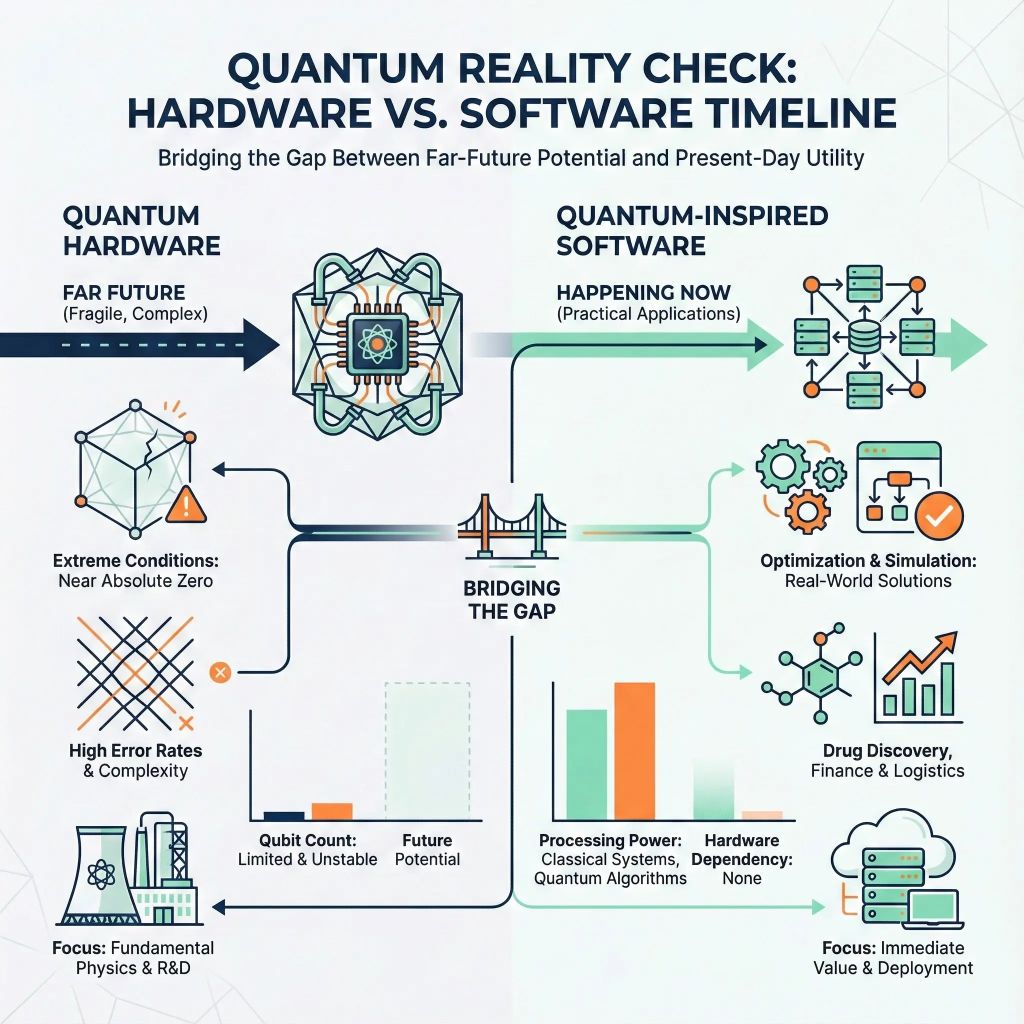
Gartner predicts that quantum computing revenue will hit $11 billion by 2027, but the real impact will be felt through quantum-inspired software running on regular computers. We won’t need quantum hardware to benefit from quantum thinking.
Expect to see:
- Calendar apps that actually understand context: Scheduling tools that consider your energy patterns, commute time, meeting dynamics, and personal preferences simultaneously
- Project management with uncertainty: Tools that plan for multiple scenarios and adapt in real-time based on changing conditions
- Decision support that thinks like you: Software that mirrors human decision-making patterns rather than forcing linear thinking
The companies already working on this include established players like IBM and Google, but also startups like Cambridge Quantum Computing and Xanadu, who are building quantum-inspired optimization tools for everyday business problems.

My Take on This Quantum Shift
I’m optimistic about quantum computing practical applications, but let’s be realistic about timelines.
Full-scale quantum computers that outperform classical systems for general tasks? Still years away. Current quantum computers are fragile, error-prone, and require near-absolute-zero temperatures to function. You’re not getting a quantum laptop anytime soon.
But quantum-inspired algorithms running on regular computers? That’s happening now. The biggest impact isn’t going to be quantum hardware – it’s going to be quantum thinking applied to software design, optimization problems, and decision-making tools.
The behavioral psychology research is clear: humans naturally think in quantum-like patterns. We hold multiple possibilities in mind, we make decisions based on probability rather than certainty, and we’re comfortable with ambiguity until we need to commit to action.
Maybe the most exciting thing about quantum computing isn’t the technology itself – it’s the permission it gives us to build tools that finally work the way our brains actually operate.
I started this research because I was frustrated with productivity tools that assume we live in a perfectly predictable world. I’m ending it convinced that quantum thinking – whether powered by actual quantum computers or not – offers a fundamentally better approach to planning, scheduling, and decision-making.
The data shows this actually changes how we think about work itself. And for someone who’s spent years trying to optimize everything from morning routines to project workflows, that feels like the kind of shift worth paying attention to.


Leave a Reply